✨ Click anywhere or press ESC to enter immediately

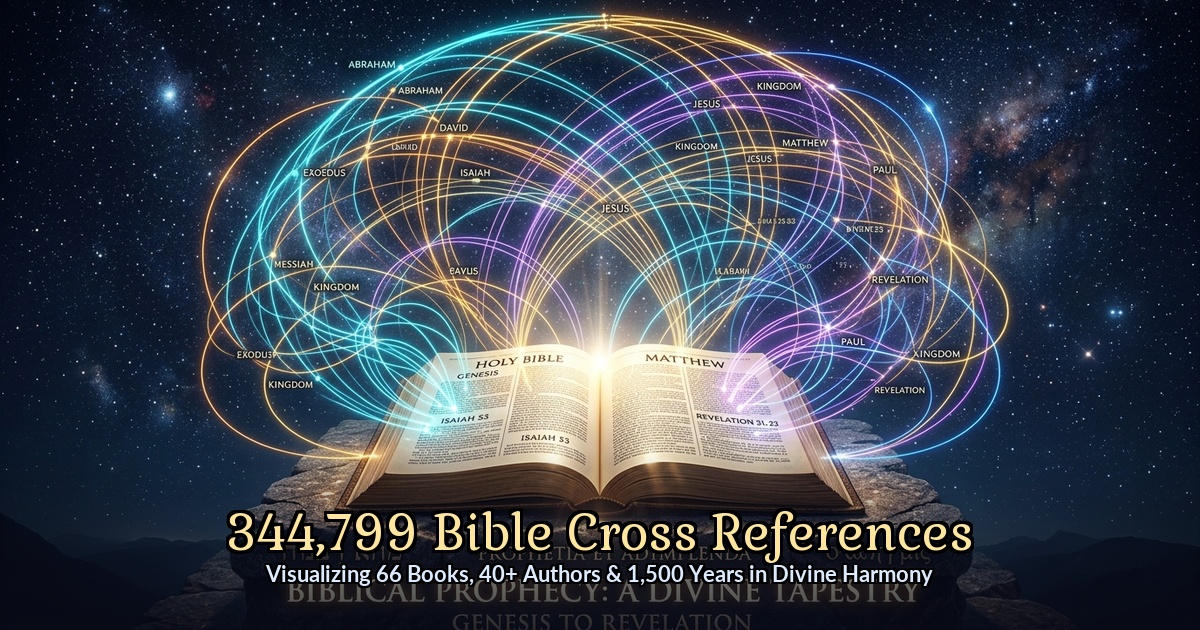
📖 Genesis opens in a pristine garden with the Tree of Life. Revelation closes in a holy city where the Tree of Life yields fruit every month. Between these two bookends lies a multi-millennial network of 344,799 verified cross-references—revealing an astonishing literary and theological unity impossible by chance.
Every chapter of the Bible laid out along the bottom baseline, scaled to its verse count. Watch hundreds of thousands of glowing arcs bridge the ancient covenants across centuries.
Explore the official investigative documentary by Bible Files. Follow along with interactive chapter markers to jump directly to any segment.
Behind every arc lies a concrete historical, theological, and literary connection. Here is how the numbers break down across the 66 canonical books.
None of these notes existed in the original Hebrew, Aramaic, and Greek manuscripts. Meet the scholars, printers, and monks who spent seventeen centuries unlocking the Bible's internal hyperlinks.
Before verse numbers existed, church historian Eusebius invented ten parallel harmony tables matching common passages across Matthew, Mark, Luke, and John. For over a thousand years, medieval scribes illuminated these tables within painted Roman arches at the front of Gospel books.

You cannot cite a reference without an address. Stephen Langton, a professor in Paris who later became Archbishop of Canterbury, divided the Latin Vulgate into the standard 1,189 chapters we still use today across both Jewish and Christian Bibles worldwide.

French scholar-printer Robert Estienne (Robertus Stephanus) introduced modern verse numbers for the New Testament while traveling on horseback between Paris and Lyon. His 1551 Greek New Testament allowed scholars to point to exact single sentences for the very first time.

The 1611 King James Version printed thousands of scholarly cross-references in its margins, allowing the average English plowboy to compare Old Testament prophecies with their New Testament fulfillments. Subsequent Victorian editions expanded this margin web to tens of thousands of links.

Publisher Samuel Bagster compiled over 380,000 cross-references into a landmark single reference volume: The Treasury of Scripture Knowledge. For nearly two centuries, it stood as the undisputed monumental dictionary of Scriptural interconnections.

In 2007, computer scientist Chris Harrison and Lutheran pastor Christoph Römhild mapped 63,779 links into their iconic rainbow arc graphic, captivating millions worldwide. Today, OpenBible.info has expanded the public domain dataset to 344,799 verified references.

When you pull on a single thread in Scripture, the entire tapestry moves. Here are the four most profound cross-reference case studies examined in the video.
Tracing the sacrificial Lamb across 5 books, 40 generations, and 1,500 years
In Genesis 22:8, Isaac turns to his father Abraham on Mount Moriah and asks, "Where is the lamb for a burnt offering?" Abraham prophetically replies: "God will provide himself a lamb." Follow that single phrase across the centuries:
Abraham looks and sees a ram caught in the thicket. The ultimate Lamb is reserved for the future.
The blood of the lamb saves every firstborn in Israel from judgment in Egypt.
Isaiah reveals 700 years before Christ that the Lamb is a person carrying our griefs.
John the Baptist identifies Jesus of Nazareth as the fulfillment of Abraham's prophecy.
The culmination of human history: the Lamb who was slain is worshipped for eternity.
Written by King David ~1000 BC, centuries before crucifixion was invented
The open cross-reference dataset contains 67 distinct links connecting King David's Psalm 22 to the crucifixion narratives across Matthew 27, Mark 15, Luke 23, and John 19. Notice the exact word-for-word fulfillments:
| Prophecy in Psalm 22 (c. 1000 BC) | Gospel Fulfillment (c. 33 AD) | Thematic Connection |
|---|---|---|
| Psalm 22:1: "My God, my God, why hast thou forsaken me?" | Matthew 27:46: "Eli, Eli, lama sabachthani? that is to say, My God, my God, why hast thou forsaken me?" | Jesus recites the opening line of Psalm 22 from the cross. |
| Psalm 22:7-8: "He trusted on the LORD that he would deliver him: let him deliver him, seeing he delighted in him." | Matthew 27:43: "He trusted in God; let him deliver him now, if he will have him: for he said, I am the Son of God." | Chief priests and elders mock Christ using David's verbatim quotation. |
| Psalm 22:16: "For dogs have compassed me... they pierced my hands and my feet." | John 20:25: "Except I shall see in his hands the print of the nails, and put my finger into the print of the nails..." | Predicts physical piercing of extremities centuries before Roman crucifixion. |
| Psalm 22:18: "They part my garments among them, and cast lots upon my vesture." | John 19:24: "They said therefore among themselves, Let us not rend it, but cast lots for it, whose it shall be..." | Roman soldiers roll dice for Jesus' seamless tunic at the foot of the cross. |
How Genesis 1–3 and Revelation 20–22 form a perfect literary chiasm
There are 210 documented cross-references connecting Genesis directly to Revelation. What was lost in Genesis 1–3 is systematically and completely restored in Revelation 20–22:
| Genesis (Paradise Lost) | Revelation (Paradise Restored) | Symmetrical Resolution |
|---|---|---|
| Genesis 1:1: Creation of the first heavens and first earth. | Revelation 21:1: "I saw a new heaven and a new earth: for the first heaven and the first earth were passed away." | Cosmic renewal |
| Genesis 3:1-4: Satan appears as the deceptive serpent to tempt humanity. | Revelation 20:2, 10: "He laid hold on the dragon, that old serpent... and cast him into the lake of fire." | The serpent crushed |
| Genesis 3:24: Tree of Life barred by flaming sword and cherubim. | Revelation 22:2, 14: "On either side of the river was the Tree of Life... Blessed are they that have right to the tree." | Tree of Life regained |
| Genesis 3:17-19: The curse enters creation; sweat, pain, and death. | Revelation 22:3: "And there shall be no more curse: but the throne of God and of the Lamb shall be in it." | The curse eradicated |
| Genesis 3:19: Death enters: "Dust thou art, and unto dust shalt thou return." | Revelation 21:4: "And there shall be no more death, neither sorrow, nor crying, neither shall there be any more pain." | Death swallowed in victory |
The two verses in human history that collect the highest density of cross-references
"But ye are a chosen generation, a royal priesthood, an holy nation, a peculiar people; that ye should shew forth the praises of him who hath called you out of darkness into his marvellous light."
Why is this verse #1? Because in one sentence, Peter synthesizes the promises of Exodus 19:5-6, Deuteronomy 7:6, Isaiah 43:20-21, Isaiah 61:6, and Hosea 1:9-10—demonstrating that the Gentile and Jewish believers in Jesus have received the ultimate royal calling of Israel.
"For unto us a child is born, unto us a son is given: and the government shall be upon his shoulder: and his name shall be called Wonderful, Counsellor, The mighty God, The everlasting Father, The Prince of Peace."
Every gospel writer, epistle author, and prophecy commentator loops back to this declaration. It bridges the Davidic covenant (2 Samuel 7), the Virgin birth (Isaiah 7:14), Christ's deity (John 1:1), and His eternal reign (Revelation 19:16).
Does this massive network prove divine inspiration, or does it merely prove that later authors read and copied earlier ones? Let's examine the evidence fairly from both perspectives.
Neither side claims these connections are accidents. The question is far deeper: How did dozens of independent writers, separated by empires, languages, and centuries of war and exile, end up telling what billions of people across human history read as one single story?
Click any image to enter full Lightbox Mode. Test your biblical and historical knowledge with the interactive educational challenge underneath each visualization.

Divine light piercing the primordial deep, echoing the opening of John 1:1.
The earliest recorded systematic Gospel cross-referencing tool in church history.
Dividing ancient scrolls into 1,189 standard chapters at the University of Paris.
The Protestant Geneva printing revolution that gave us modern 31,102 verses.
Empowering common readers with thousands of marginal cross-reference links.
The historic 380,000-link encyclopedia that proved Scripture interprets Scripture.
Data visualization showing 73,000+ bridges spanning the Old and New Testaments.

The radiant crimson ribbon connecting every sacrifice in Scripture to Calvary.

"God will provide himself a lamb" — Abraham's prophecy on the mount of sacrifice.

The unblemished lamb whose unbroken bones foreshadowed Christ our Passover.

Led as a lamb to the slaughter 700 years before Calvary took place.

John the Baptist points across the water: "Behold the Lamb of God!"

Gazing into prophetic prayer on Mount Zion: "They pierced my hands and my feet."

Christ opening the ancient scrolls, explaining how all 39 books speak of Him.

The River of Life flowing from the Throne of the Lamb: "And there shall be no more curse."
What historical or theological event does this image show?
This project is compiled from public domain and peer-reviewed biblical scholarship: